Observing the Transit of Venus
WARNING : Never observe the Sun with the naked eye or a telescope, camera or other optical device. Doing so will seriously damage your eye sight and may lead to permanent blindness . Both the eye and artificial optical devices concentrate the extremely strong ultraviolet light from the Sun onto the retina. This can permanently destroy the retina's ability to detect light. To safely observe the Transit of Venus you must use the indirect methods outlined below.
NEVER OBSERVE THE SUN WITH THE NAKED EYE OR THROUGH A TELESCOPE, CAMERA OR OTHER OPTICAL DEVICE
In this section we will guide you through the best options for safely observing the Transit safely. If you want to try to take some measurements you should also look at our Transit Calculator page.
Four safe routes to Venus observing heaven
To safely observe this event you can do one of the following:
These are explained in more detail below. Clearly the more time you have the better and more elaborate your observations can be! What the last three methods have in common is that they project an image of the Sun - you can safely observe the Sun because you are looking at it indirectly and taking some simple precautions. If possible we recommend you try your equipment out before hand, and try and locate some sunspots - things may not be as you expect! Use the latest SOHO MDI image to find out if any sunspots are available.
Indirect projection is the method we recommend as the safest way to observe the Sun. In this way the light from the Sun is viewed after it has been reflected from a screen, reducing the brightness to safe levels. As the alternative is blindness, we think this is well worth the effort!
Back to top of page.
Pinhole projector
This is the simplest way to assemble your own equipment. You won't be making high-quality observations with this, but on a clear, bright day you should be able to have a stab at timing the Contacts as Venus starts and finishes its pass across the Sun - see our Transit Calculator for more details of these timings..
Simply take a piece of stiff card. Pierce it with a pin. Hold it up and looking away from the Sun adjust the angle of the card until its shadow is minimised - for example a rectangular piece of card will have a rectangular shadow! The pinhole will project an image of the Sun into the middle of the shadowed area. Place another piece of card under the shadow and adjust the distance between the two to get the best picture - more distant gives a larger but fainter image. If you have time you can get elaborate and attach the two parts together with rigid dowel or similar. The hole must be clean and as small as possible - otherwise you will simply get a shaft of light.

Image from South African Agency for Science and Technology Advancement. It shows how you can reinforce the pinhole with tin foil. Note the image will be small, and it will be tricky to make out Venus.
NEVER OBSERVE THE SUN WITH THE NAKED EYE OR THROUGH A TELESCOPE, CAMERA OR OTHER OPTICAL DEVICE
Back to top of page.
Simple projection kit
There are a number of equipment sets allowing you to observe the Sun safely. One of the simplest is the so-called Solarscope. This consists of a small lens, a small mirror and a supporting structure that doubles as a shade and projection screen. When using this equipment it may well get hot over a six hour event like the Transit - it is probably worth letting it rest by shading it every 30 minutes or so.

The image (from Solarscope) shows the three versions available - a wooden-framed model, a large cardboard model for large groups and a small cardboard model for small groups. The last of these is about 26 x 37 cm across the base and 42 cm tall. They come flat-packed for delivery so require some assembly. The instructions are pretty clear, both for assembly and use. Vendors in the UK include:
The University of Central Lancashire does not endorse any of these suppliers, and this list is not necessarily complete.
NEVER OBSERVE THE SUN WITH THE NAKED EYE OR THROUGH A TELESCOPE, CAMERA OR OTHER OPTICAL DEVICE
Back to top of page.
Solar projection telescope
An alternative, for those with time and a greater budget, is to carry out your indirect viewing using a solar projection screen attached to a refracting telescope. There are a wide range of refracting telescopes available, ranging from £50 devices up into the thousands of pounds. As a refracting telescope is particularly useful for observing planets, it will be of use after the Transit for both night and day time astronomy.
We are using a Skywatcher Evostar 102 mm diameter refractor with an EQ3-2 mount and drive. This can follow the Sun around the sky, once it is lined up. The telescope has been modified to mount a projection screen. This is simply a light-weight notice board (of the type used with drawing pins) painted black and mounted on a tube to support it at the rear of the telescope. The tube is attached to the telescope using rain goods components (i.e. down spout clips!) so that everything moves together. The advantage of a 100 mm diameter telescope is that standard fittings can be used.
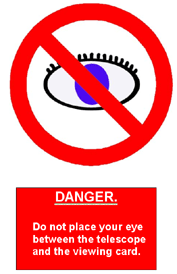
The whole thing might cost you between £250 and £500 and a few hours DIY depending how you go about it. This is about the safest arrangement we can come up with. The only point to be careful of is at the eyepiece, where light from a 100 mm aperture is concentrated on a tiny spot - this is about 10,000 times the amount of light gathered by your eye, and will cause immediate blindness. As long as you keep eyes away from that point, and heads out from between the telescope and the projection screen, you should be perfectly safe. As with the Solarscope the equipment may get hot over the course of the 6 hour event, so it is probably worth shading it every 30 minutes or so to let it cool.
NEVER OBSERVE THE SUN WITH THE NAKED EYE OR THROUGH A TELESCOPE, CAMERA OR OTHER OPTICAL DEVICE
Back to top of page.
Safety precautions
- Warn anyone observing not to look at the Sun.
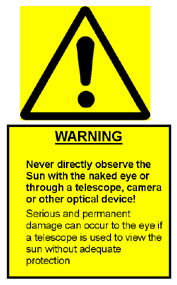
- Use safety notices (such as the one on the right) as warnings.
- Be vigilant about where light is shining and do not hesitate to act if you feel someone is at risk.
- Be sure that any equipment you use is functioning as expected.
Amateur astronomers should note that projecting the Sun results in the inside of the telescope becoming extremely hot. This means the glues used in many high-quality eye-pieces and telescopes can melt. Thus we strongly recommend the use of a refracting telescope and a cheap eye-piece for projecting the Sun.
Back to top of page.
What you can expect to see
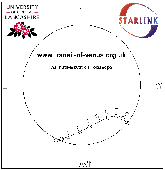
Every where on the web we see a picture of the Transit of Venus showing the planet following a straight track across the lower half of the Sun's disc.
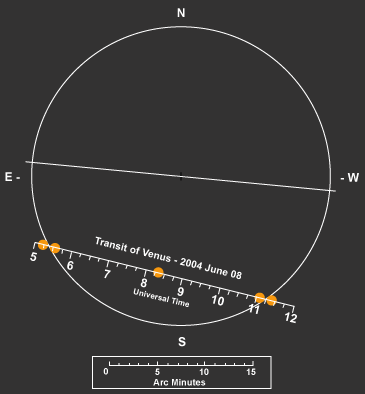
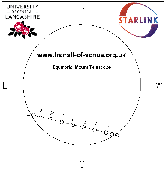
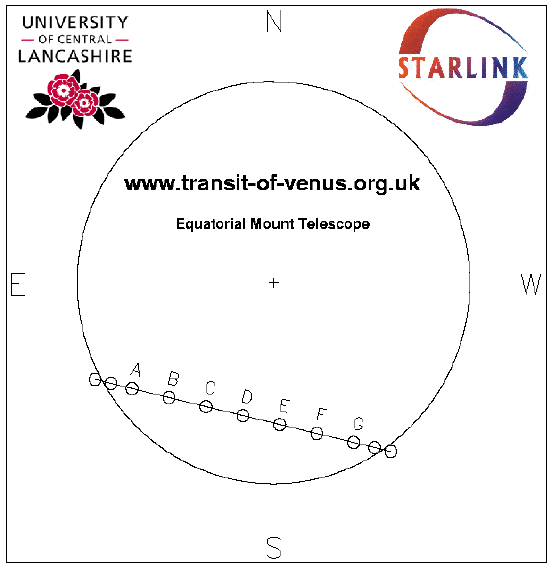
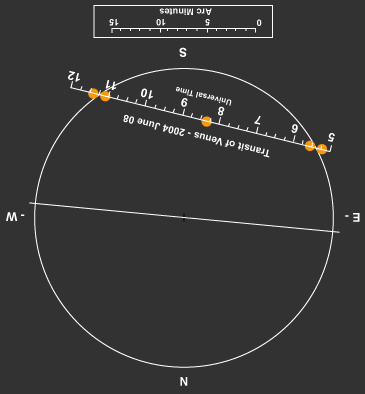
However how you view the Transit will change this picture. For example, if you use a solar projection telescope it will be rotated through 180 degrees, so that Venus will appear at the "top right" instead of the "bottom left". This is because the telescope inverts the image, and the projection reverses it. Exactly the same happens with a Solarscope because the lens inverts the image, then the mirror reverses it.
The Skywatcher telescope we discussed above uses an Equatorial mount, which simply means it rotates around the same axis as the Earth, making it easy to follow the stars. Many modern telescopes are instead mounted to move relative to the Earth's surface (Elevation-Azimuth telescopes - also known as Altitude-Azimuth or AltAz), and the Solarscope also operates on this principle. This is important because it changes the apparent path of Venus across the Sun into a curve!
The up shot of this is that it is quite difficult to determine exactly where First Contact (as Venus enters the Sun's disc) will occur for a given set of equipment.
Black drop effect is the apparent "stretching" of the disc of Venus as it separates from the edge of the Sun's disc. This is not due to the atmosphere of Venus, but instead due to the observing equipment resolution - in other words due to the fact that Transits of Venus have been observed with small telescopes.
Venus' atmospheric halo has also been reported. This is literally a thin ring of light around the planet, due to light being bent through its atmosphere. You will do well to see this as it is a thing ring around the already fairly small Venusian disc.
NEVER OBSERVE THE SUN WITH THE NAKED EYE OR THROUGH A TELESCOPE, CAMERA OR OTHER OPTICAL DEVICE
Back to top of page.
Transit of Venus 8th June 2004
On the morning of Tuesday the 8th June 2004, people throughout the day-lit portions of the globe will be able to see the Transit of Venus across the disc of the Sun. The table below shows the predicted times of first to fourth contact at Carr House, the location of Jeremiah Horrocks' observation in 1639. These are given in Greenwich Mean Time (= Universal Time) and British Summer Time. You will need to account for your longitude to use these times east or west of Carr House.
| Event |
GMT |
BST |
| First contact (start) |
05:19
|
06:19
|
| Second contact |
05:39 |
06:39 |
| Greatest transit (middle) |
08:22
|
09:22
|
| Third contact |
11:03
|
12:03
|
| Fourth contact (end) |
11:23
|
12:23
|
However, as explained in our Science section, the silhouette of Venus appears at different points on the Sun's disc from different places on Earth. This means that in some places the part of the disc Venus is crossing is wider or narrower than assumed for these times. Consequently the exact times of the events will vary depending upon where you are. Fred Espenak at the Goddard Space Flight Centre provides an excellent and comprehensive listing of the times.
NEVER OBSERVE THE SUN WITH THE NAKED EYE OR THROUGH A TELESCOPE, CAMERA OR OTHER OPTICAL DEVICE
DISCLAIMER : The University of Central Lancashire has taken all reasonable care to ensure that the information on this web page was accurate on 5th January 2004 but does not warrant that it is accurate or complete, and disclaims liability (except in where death or personal injury arises from the negligence of the University) to the fullest extent allowed by law for all and any damage, injury and/or loss (whether direct or indirect, consequential or economic) caused or suffered as a result of use of or reliance on that information. This disclaimer is made without prejudice to the effect of the University?s disclaimer to which a link appears below.
Back to top of page.
A note on solar filters
Many people will be looking at the Transit using either "eclipse shades" or solar filtered telescopes. While in principle these can be perfectly safe, we advise against such methods. Think about it - in most cases all that stands between you and severe eye damage is a thin film of reflecting material, probably assembled by someone else! The alternatives of image projection promoted on this page are very much simpler to carry out safely.
Back to top of page.
|